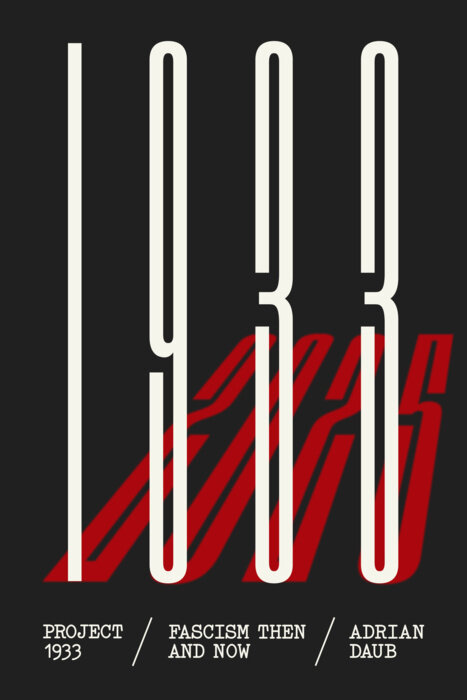
As soon as the new wave of far right politics entered American public life a decade ago, Americans have drawn comparisons to the rise of the National Socialists in 1930s Germany. Political scientists and pundits have chided people for what they see as overly facile comparisons between today’s Republican leadership and Nazism. Are these comparisons scare-mongering or hysteria? Or can they tell us something useful about the state of American democracy? Can they give us a sense of where things are headed and what might be done?
Using the writings of German thinkers like Thomas Mann, Victor Klemperer, Hannah Arendt, and many less-known diarists of the era, Project 1933 retells the story of the first year of the Third Reich month-by-month, pausing to draw connections between Germany’s past and America’s present. Adrian Daub explores the truths of living under fascism—the grim uncertainty (and even grimmer certainty) of early days, the existential scramble to cleave to institutions that define us even as they are bent to the will of a despot, the creation of bystanders and collaborators, the shifting cultural conversations, and the day-to-day banalities.
While some parallels are downright terrifying, Project 1933 aims to remind readers of the choices that are available to us, and that fascism’s key magic trick is to convince us of its own inevitability. Project 1933 shows readers a path toward a more hopeful, moral imagination and the possibility of radical change.
“A riveting chronicle of Germany’s swift transformation from parliamentary democracy to fascist dictatorship that holds a mirror to contemporary developments in our own country. Adrian Daub commendably resists facile comparisons between then and now, noting dissimilarities while alerting us to the resonant echoes. As we hurtle toward the next election, Project 1933 is required reading.”
—Rebecca Donner, New York Times bestselling author of All The Frequent Troubles of Our Days